
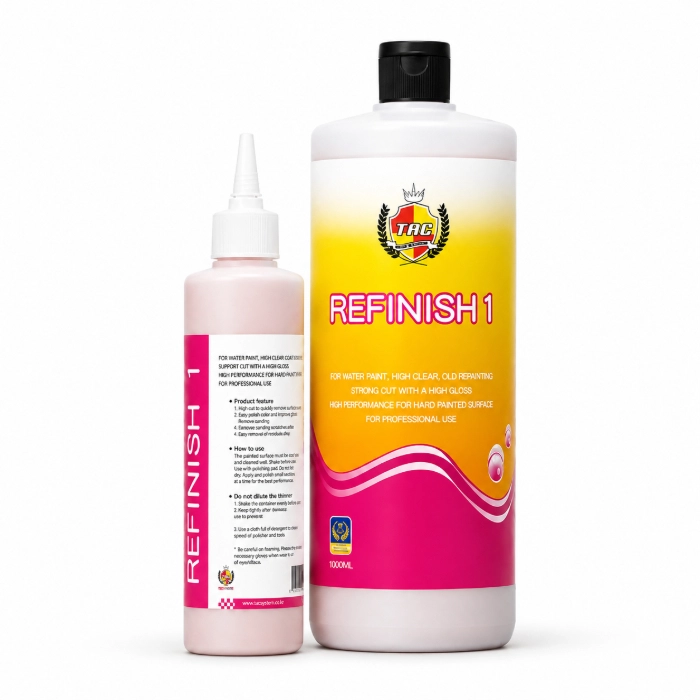
REFINISH1
POLISHING COMPOUND
Application: Heavy paint correction & polishing for automotive painted surfaces
Volume: 250 mL / 1,000 mL
Type: Water-Based Polishing Compound
Cutting Performance: Heavy Cut
Recommended Use: Rotary / Dual Action Polisher / Hand Application
FEATURES
Heavy Cut. High Gloss. Advanced Water-Based Technology.
TACSYSTEM REFINISH1 is a high-performance water-based polishing compound specially developed for intensive paint correction across a wide range of automotive paint systems, including water-based paint finishes.
Designed for demanding correction work, REFINISH1 delivers powerful cutting performance to remove severe oxidation, water spots, heavy swirl marks, sanding marks, localized paint defects, and moderate-to-heavy scratches while achieving an impressively high-gloss finish.
REFINISH1 is formulated with natural resin and highly durable silica-based abrasive particles. Its advanced abrasive technology provides strong, controlled cutting performance while minimizing unnecessary marring during the correction process.
Capable of removing sanding marks as coarse as approximately P600, REFINISH1 provides the aggressive correction required for heavily damaged surfaces while leaving a refined finish that can significantly reduce the amount of work required in subsequent polishing stages.
- Heavy Cutting Performance – Designed for intensive correction of heavily damaged automotive paint.
- P600 Sanding Mark Removal – Capable of correcting sanding marks as coarse as approximately P600 under appropriate working conditions.
- Severe Oxidation Removal – Effectively corrects heavily oxidized and weathered paint surfaces.
- Water Spot Removal – Helps remove stubborn mineral deposits and water-spot defects from the paint surface.
- Heavy Swirl Mark Correction – Powerful abrasive performance removes severe swirl marks and paint defects.
- Scratch Correction – Helps remove or significantly reduce moderate-to-heavy paint scratches where the defect is within the correctable clear-coat layer.
- High-Gloss Finish – Combines aggressive cutting performance with excellent finishing characteristics.
- Low Marring – Advanced abrasive technology helps minimize unnecessary secondary defects during polishing.
- Water-Based Formula – Developed as part of TACSYSTEM's advanced water-based REFINISH polishing system.
- Low Dust – Produces minimal polishing dust for a cleaner and more efficient correction process.
- Silicone-Free – Suitable for professional paint-correction and refinishing workflows where silicone-free products are preferred.
- Rotary & DA Compatible – Suitable for use with rotary and dual-action polishers as well as hand application.
REFINISH TECHNOLOGY
The Evolution of Polishing Compounds
Automotive polishing compounds have evolved significantly in abrasive shape, particle size, carrier technology, cutting performance, and finishing quality.
TACSYSTEM developed the REFINISH series to move beyond conventional petroleum-based polishing compounds and create a more efficient water-based paint-correction system.
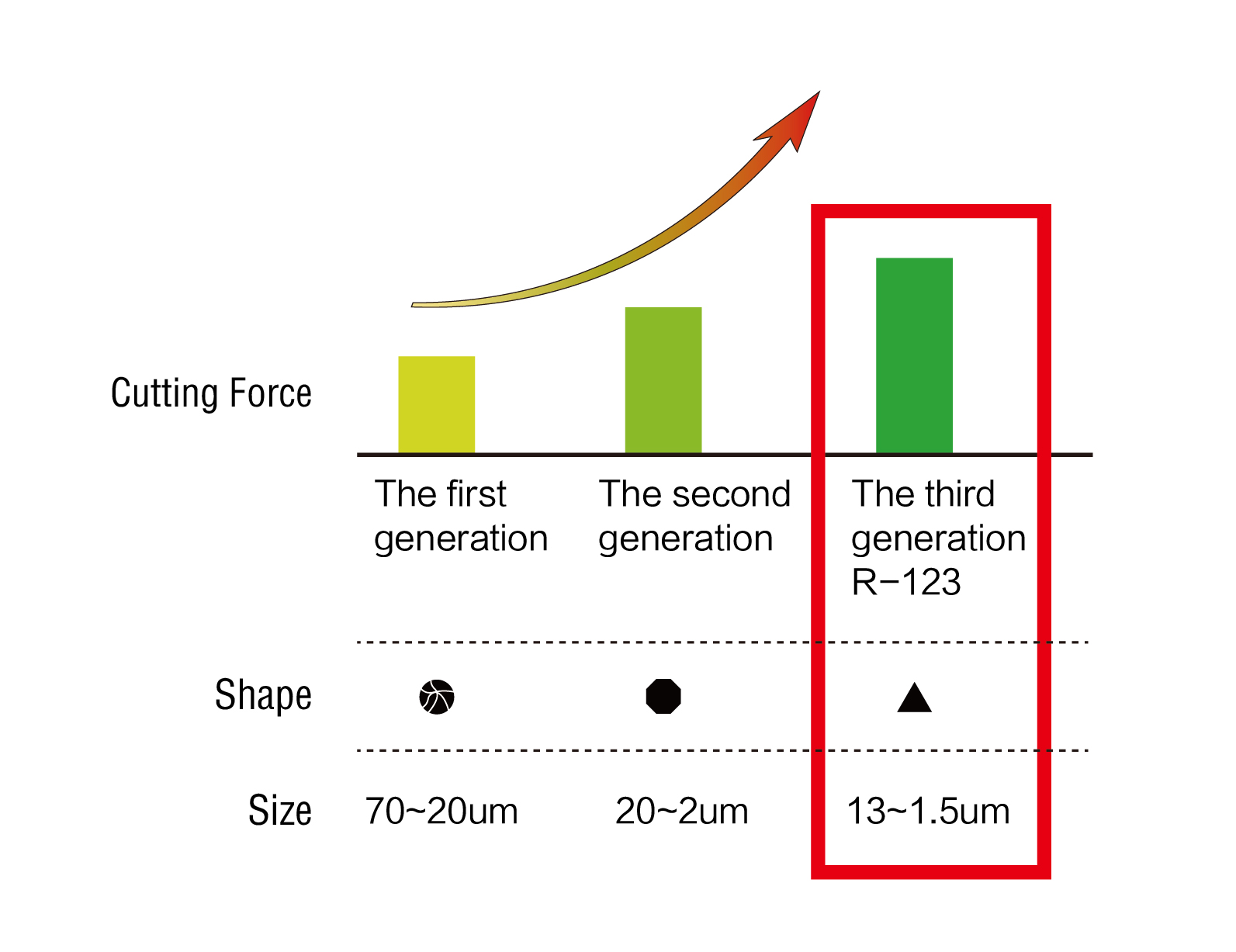
1ST GENERATION — TRADITIONAL ABRASIVES
First-generation polishing compounds used irregularly shaped abrasive particles ranging approximately from 70–20 μm.
During polishing, these particles could break down irregularly, potentially creating additional fine surface defects as correction progressed.
As a result, detailers typically needed to perform multiple polishing stages, gradually moving from aggressive cutting compounds to progressively finer finishing compounds.
This traditional correction process could require several stages before achieving the desired level of clarity and gloss.
2ND GENERATION — REFINED ABRASIVE TECHNOLOGY
Second-generation compounds were developed to provide greater control over the abrasive breakdown process.
These compounds adopted more uniform abrasive particles, described as having an approximately octagonal structure, with particle sizes ranging from approximately 20–2 μm.
The more controlled abrasive geometry helped reduce unnecessary swirl marks and secondary defects compared with earlier compound technology.
However, both first- and second-generation polishing compounds were commonly based on petroleum-derived carrier systems.
3RD GENERATION — TACSYSTEM REFINISH
Advanced Water-Based Abrasive Technology
While conventional second-generation compounds remained widely used, TACSYSTEM developed its third-generation REFINISH R1, R2, and R3 water-based polishing system.
The REFINISH abrasive structure is designed around a multi-faceted geometry that can be represented as a triangular profile in two dimensions.
This engineered abrasive structure provides powerful and efficient cutting action compared with conventional polishing technologies.
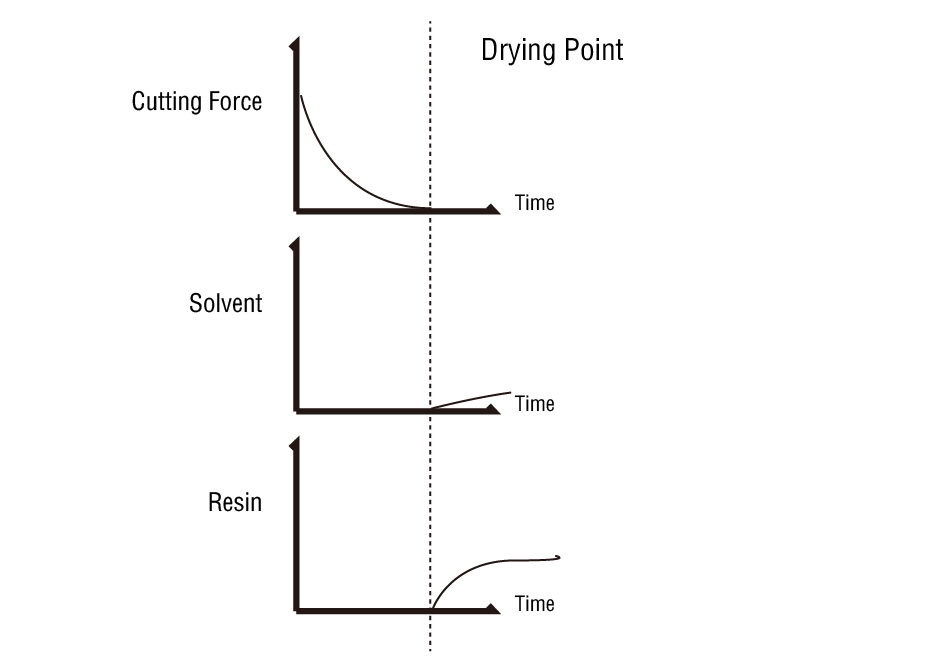
As polishing progresses and moisture gradually evaporates, the cutting action of the REFINISH compound decreases in a controlled manner.
The resin system then helps surround the abrasive particles as the product reaches the end of its working cycle, reducing uncontrolled abrasive action and helping minimize unnecessary surface damage.
The result is a more efficient correction process that combines strong initial cutting performance with progressively refined finishing characteristics.
For many paint-correction applications, this can help reduce the number of polishing stages required while still achieving excellent surface clarity and gloss.
POWERFUL CUT + REFINED FINISH
Aggressive Correction Without Sacrificing Finish Quality
REFINISH1 is the heavy-cutting stage of the TACSYSTEM REFINISH polishing system.
Its durable silica-based abrasives provide the cutting power required to tackle severe paint defects, including:
- P600 sanding marks
- Heavy oxidation
- Severe swirl marks
- Water spots
- Localized paint defects
- Moderate-to-heavy correctable scratches
As the polishing cycle progresses, the cutting action becomes progressively more refined, helping REFINISH1 achieve an impressively high level of gloss for a heavy-cut compound.
This combination of cutting power and finishing ability can reduce the amount of refinement required during subsequent paint-correction stages.
WHY POLISH AUTOMOTIVE PAINT?
Restore Clarity by Correcting Defects in the Clear Coat
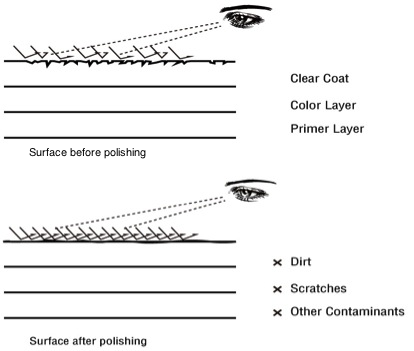
A typical automotive paint system consists of several layers, including primer, color coat, and clear coat.
The clear coat forms the outer protective layer and plays a major role in the gloss, depth, and reflectivity of automotive paint.
Over time, environmental exposure, improper washing, contamination, oxidation, water spots, and surface scratches can create microscopic defects in the clear coat.
These defects scatter reflected light instead of allowing it to reflect uniformly from the surface. As a result, the paint may appear dull, hazy, scratched, or less reflective.
Professional paint correction removes or reduces a controlled amount of the affected clear-coat surface to level correctable defects and restore a smoother, more uniform finish.
By correcting these imperfections, light can reflect more evenly from the paint, resulting in improved clarity, depth, gloss, and overall appearance.
DIRECTIONS FOR USE
- Shake well before use.
- Make sure the paint surface is clean, cool, and free of loose contamination before polishing.
- Always begin with a new or thoroughly cleaned polishing pad. A contaminated or excessively loaded pad may introduce additional surface defects.
- Apply an appropriate amount of REFINISH1 evenly across the face of the polishing pad.
- Spread the compound over the working area before beginning the main correction cycle.
- Work the product using a rotary or dual-action polisher with an appropriate cutting pad. REFINISH1 may also be used by hand where appropriate.
- Polish the section using controlled movements until the desired level of correction has been achieved.
- Remove remaining compound residue with a clean microfiber towel.
- Inspect the corrected surface under suitable lighting.
- Repeat where necessary, taking care to maintain an appropriate and safe level of clear-coat removal.
TIP: Clean the polishing pad frequently during use. Paint residue, spent abrasive, and contamination can accumulate in the pad and reduce polishing performance or contribute to additional surface marring.
ROTARY + DUAL ACTION POLISHING
REFINISH1 can be used with both rotary and dual-action (DA) polishers, allowing the cutting performance to be adapted to different paint systems, defects, pads, and correction requirements.
For maximum correction performance, always select an appropriate polishing pad and regularly inspect both the pad and paint surface throughout the polishing process.
Because paint hardness, clear-coat thickness, defect depth, machine type, pad selection, pressure, speed, and working time can all affect the final result, professional judgment should be used when performing aggressive paint correction.
RECOMMENDED REFINISH WORKFLOW
Cut. Refine. Finish.
REFINISH1 is designed as the heavy-cut correction stage within the TACSYSTEM REFINISH polishing system.
REFINISH1 — Heavy Correction
For severe oxidation, sanding marks, heavy swirl marks, water spots, and deeper correctable paint defects.
REFINISH2 — Refinement
For refining the surface after heavy correction and removing remaining intermediate defects.
REFINISH3 — Final Finish
For maximizing surface clarity and gloss while removing fine polishing marks where required.
The exact number of polishing stages depends on the paint system, condition of the vehicle, desired finish, and correction method.
CAUTIONS
- Avoid working in direct sunlight or on hot painted surfaces.
- Make sure the paint surface is sufficiently cool before use.
- Do not allow the product to dry completely on the paint surface.
- Always wear a protective mask and suitable gloves during use.
- In case of skin contact, rinse thoroughly with water.
- In case of contact with eyes, rinse immediately with plenty of water and seek medical attention.
- If swallowed, seek medical attention immediately and show the product container or label to medical personnel.
REFINISH1
POLISHING COMPOUND
Application: Heavy paint correction & polishing for automotive painted surfaces
Volume: 250 mL / 1,000 mL
Type: Water-Based Polishing Compound
Cutting Performance: Heavy Cut
Recommended Use: Rotary / Dual Action Polisher / Hand Application
FEATURES
Heavy Cut. High Gloss. Advanced Water-Based Technology.
TACSYSTEM REFINISH1 is a high-performance water-based polishing compound specially developed for intensive paint correction across a wide range of automotive paint systems, including water-based paint finishes.
Designed for demanding correction work, REFINISH1 delivers powerful cutting performance to remove severe oxidation, water spots, heavy swirl marks, sanding marks, localized paint defects, and moderate-to-heavy scratches while achieving an impressively high-gloss finish.
REFINISH1 is formulated with natural resin and highly durable silica-based abrasive particles. Its advanced abrasive technology provides strong, controlled cutting performance while minimizing unnecessary marring during the correction process.
Capable of removing sanding marks as coarse as approximately P600, REFINISH1 provides the aggressive correction required for heavily damaged surfaces while leaving a refined finish that can significantly reduce the amount of work required in subsequent polishing stages.
- Heavy Cutting Performance – Designed for intensive correction of heavily damaged automotive paint.
- P600 Sanding Mark Removal – Capable of correcting sanding marks as coarse as approximately P600 under appropriate working conditions.
- Severe Oxidation Removal – Effectively corrects heavily oxidized and weathered paint surfaces.
- Water Spot Removal – Helps remove stubborn mineral deposits and water-spot defects from the paint surface.
- Heavy Swirl Mark Correction – Powerful abrasive performance removes severe swirl marks and paint defects.
- Scratch Correction – Helps remove or significantly reduce moderate-to-heavy paint scratches where the defect is within the correctable clear-coat layer.
- High-Gloss Finish – Combines aggressive cutting performance with excellent finishing characteristics.
- Low Marring – Advanced abrasive technology helps minimize unnecessary secondary defects during polishing.
- Water-Based Formula – Developed as part of TACSYSTEM's advanced water-based REFINISH polishing system.
- Low Dust – Produces minimal polishing dust for a cleaner and more efficient correction process.
- Silicone-Free – Suitable for professional paint-correction and refinishing workflows where silicone-free products are preferred.
- Rotary & DA Compatible – Suitable for use with rotary and dual-action polishers as well as hand application.
REFINISH TECHNOLOGY
The Evolution of Polishing Compounds
Automotive polishing compounds have evolved significantly in abrasive shape, particle size, carrier technology, cutting performance, and finishing quality.
TACSYSTEM developed the REFINISH series to move beyond conventional petroleum-based polishing compounds and create a more efficient water-based paint-correction system.
1ST GENERATION — TRADITIONAL ABRASIVES
First-generation polishing compounds used irregularly shaped abrasive particles ranging approximately from 70–20 μm.
During polishing, these particles could break down irregularly, potentially creating additional fine surface defects as correction progressed.
As a result, detailers typically needed to perform multiple polishing stages, gradually moving from aggressive cutting compounds to progressively finer finishing compounds.
This traditional correction process could require several stages before achieving the desired level of clarity and gloss.
2ND GENERATION — REFINED ABRASIVE TECHNOLOGY
Second-generation compounds were developed to provide greater control over the abrasive breakdown process.
These compounds adopted more uniform abrasive particles, described as having an approximately octagonal structure, with particle sizes ranging from approximately 20–2 μm.
The more controlled abrasive geometry helped reduce unnecessary swirl marks and secondary defects compared with earlier compound technology.
However, both first- and second-generation polishing compounds were commonly based on petroleum-derived carrier systems.
3RD GENERATION — TACSYSTEM REFINISH
Advanced Water-Based Abrasive Technology
While conventional second-generation compounds remained widely used, TACSYSTEM developed its third-generation REFINISH R1, R2, and R3 water-based polishing system.
The REFINISH abrasive structure is designed around a multi-faceted geometry that can be represented as a triangular profile in two dimensions.
This engineered abrasive structure provides powerful and efficient cutting action compared with conventional polishing technologies.
As polishing progresses and moisture gradually evaporates, the cutting action of the REFINISH compound decreases in a controlled manner.
The resin system then helps surround the abrasive particles as the product reaches the end of its working cycle, reducing uncontrolled abrasive action and helping minimize unnecessary surface damage.
The result is a more efficient correction process that combines strong initial cutting performance with progressively refined finishing characteristics.
For many paint-correction applications, this can help reduce the number of polishing stages required while still achieving excellent surface clarity and gloss.
POWERFUL CUT + REFINED FINISH
Aggressive Correction Without Sacrificing Finish Quality
REFINISH1 is the heavy-cutting stage of the TACSYSTEM REFINISH polishing system.
Its durable silica-based abrasives provide the cutting power required to tackle severe paint defects, including:
- P600 sanding marks
- Heavy oxidation
- Severe swirl marks
- Water spots
- Localized paint defects
- Moderate-to-heavy correctable scratches
As the polishing cycle progresses, the cutting action becomes progressively more refined, helping REFINISH1 achieve an impressively high level of gloss for a heavy-cut compound.
This combination of cutting power and finishing ability can reduce the amount of refinement required during subsequent paint-correction stages.
WHY POLISH AUTOMOTIVE PAINT?
Restore Clarity by Correcting Defects in the Clear Coat
A typical automotive paint system consists of several layers, including primer, color coat, and clear coat.
The clear coat forms the outer protective layer and plays a major role in the gloss, depth, and reflectivity of automotive paint.
Over time, environmental exposure, improper washing, contamination, oxidation, water spots, and surface scratches can create microscopic defects in the clear coat.
These defects scatter reflected light instead of allowing it to reflect uniformly from the surface. As a result, the paint may appear dull, hazy, scratched, or less reflective.
Professional paint correction removes or reduces a controlled amount of the affected clear-coat surface to level correctable defects and restore a smoother, more uniform finish.
By correcting these imperfections, light can reflect more evenly from the paint, resulting in improved clarity, depth, gloss, and overall appearance.
DIRECTIONS FOR USE
- Shake well before use.
- Make sure the paint surface is clean, cool, and free of loose contamination before polishing.
- Always begin with a new or thoroughly cleaned polishing pad. A contaminated or excessively loaded pad may introduce additional surface defects.
- Apply an appropriate amount of REFINISH1 evenly across the face of the polishing pad.
- Spread the compound over the working area before beginning the main correction cycle.
- Work the product using a rotary or dual-action polisher with an appropriate cutting pad. REFINISH1 may also be used by hand where appropriate.
- Polish the section using controlled movements until the desired level of correction has been achieved.
- Remove remaining compound residue with a clean microfiber towel.
- Inspect the corrected surface under suitable lighting.
- Repeat where necessary, taking care to maintain an appropriate and safe level of clear-coat removal.
TIP: Clean the polishing pad frequently during use. Paint residue, spent abrasive, and contamination can accumulate in the pad and reduce polishing performance or contribute to additional surface marring.
ROTARY + DUAL ACTION POLISHING
REFINISH1 can be used with both rotary and dual-action (DA) polishers, allowing the cutting performance to be adapted to different paint systems, defects, pads, and correction requirements.
For maximum correction performance, always select an appropriate polishing pad and regularly inspect both the pad and paint surface throughout the polishing process.
Because paint hardness, clear-coat thickness, defect depth, machine type, pad selection, pressure, speed, and working time can all affect the final result, professional judgment should be used when performing aggressive paint correction.
RECOMMENDED REFINISH WORKFLOW
Cut. Refine. Finish.
REFINISH1 is designed as the heavy-cut correction stage within the TACSYSTEM REFINISH polishing system.
REFINISH1 — Heavy Correction
For severe oxidation, sanding marks, heavy swirl marks, water spots, and deeper correctable paint defects.
REFINISH2 — Refinement
For refining the surface after heavy correction and removing remaining intermediate defects.
REFINISH3 — Final Finish
For maximizing surface clarity and gloss while removing fine polishing marks where required.
The exact number of polishing stages depends on the paint system, condition of the vehicle, desired finish, and correction method.
CAUTIONS
- Avoid working in direct sunlight or on hot painted surfaces.
- Make sure the paint surface is sufficiently cool before use.
- Do not allow the product to dry completely on the paint surface.
- Always wear a protective mask and suitable gloves during use.
- In case of skin contact, rinse thoroughly with water.
- In case of contact with eyes, rinse immediately with plenty of water and seek medical attention.
- If swallowed, seek medical attention immediately and show the product container or label to medical personnel.